

One of the hardest aspects about being a writer is, well… writing. I don’t meant getting the words on paper (although that can be a struggle). I mean finding the time to actually write. Often, the busyness of life and all it’s stresses can take over much of each day, leaving us little time to ourselves, let alone time to be creative.
When evening comes, do you feel like you’ve been spinning in a circle all day, doing lots of things, but getting little done? And then realizing that your writing hasn’t been touched? If so, you’ve come to the right place.
With the start of this brand new year, I thought I’d share some tips and tricks to getting your days back under control, so you can have not only less stress, but also attain your writing goals.
Below are some key tips, a few pitfalls to avoid, and a list of additional resources, so you can do a deeper dive and have not only productive, but fulfilling days.
Time Management
Oh, those are words I love to hate.
Why?
Because they sound so simple but can be very challenging. The concept sounds wonderful on paper. Doing it? Not so much. But you can make time management a bit easier, if you understand some of your psychological and behavioral barriers. These barriers can include:
Too many obligations
Multi-tasking (yes, this is a problem!)
Honesty about what is important, and why you are avoiding certain tasks (ouch)
Assessing what really needs to be done (and in what general order)
Let’s talk about solutions:
Putting Out Fires
Too often, you may find yourself diving into your day with all the *things* you have to do. Like many of us, you may put your head down and barrel forward, knocking tasks down as you race through the day.
The problem with this, is that it can resemble putting out fires, only finishing the most obvious *now* tasks. Sometimes, this approach leaves us at the will of others- the kids or the spouse or (insert relationship here!) who may be pushing for time or attention. (Don’t get me wrong, these people are important, but so are you. We’ll talk below about how to re-orient all of this!)
Lists:
Creating lists is an important step in gaining control of your days. Used incorrectly, though, they can become a hinderance.
What they are:
Lists are a way to capture all those tasks creating a firestorm in your head. You can get all the *to do’s* in one place. Lists help you:
De-stress: lists can help you gain control over a frantic day, by giving you the peace of mind that you won’t forget something
Prioritize: lists allow you to decide what you will (and won’t) tackle and, in general, what order
Feel accomplished: instead of running in circles doing whatever task is right in front of you, then being dragged off to the next one…you can systematically complete tasks, cross them off the list, and have more done at the end of the day (plus have some built in time for you!).
What they are NOT:
Lists should not be a crazy long itemization of everything that has to be done in the world. If you need to make one master list like this, go ahead. Then set it aside and check out the prioritization section below.
Lists should not stress you when you don’t get everything on the list completed every day. Keep in mind, lists help you make progress, not attain perfection!
Types of Lists:
The Today (or soon) List:
Make a list of the things that really do need to get done today, or within the next few days.
Consider separating those items into simple subcategories.
Make sure one section is devoted to YOU.
For example, my daily list:
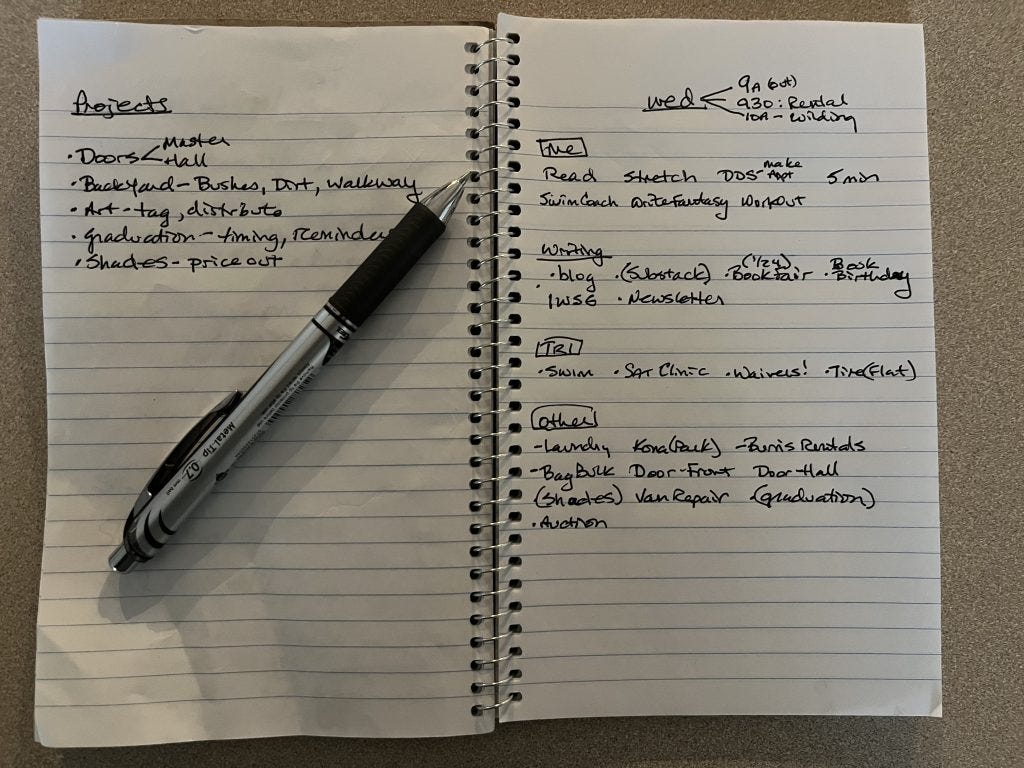
Starts at the top with a “Me” section. This contains a few simple things I need to do for myself. Adding this intentionally helps keep us from always putting others first, while wearing ourselves too thin. If I do a little something for me each day, I can give to others much more freely.
Writing: I list out things specific to my writing tasks (although writing my Fantasy is under the *me* section!) Writing today’s blog, for example, is in my “Writing” section today. (see picture below)
Triathlon:
I coach beginner triathletes. I need to remember to send practice reminders, get waivers signed, and other regular tasks.
Other:
I put all my other tasks under “Other”. This keeps me from worrying too much about where something fits in a subcategory (like ‘house cleaning’ versus ‘shopping’). Things I need to get done today (or tomorrow) around the house, are listed here.
The Longer Project/ Chore List:
Make a separate list of those tasks that will take several steps to finish or won’t need to be worked on for sometime. This is a great way to not forget a project later or to manage large, multi-step projects. In my attached example- I have “Projects” listed on a separate page. Any smaller steps of these projects needing to be completed today (or soon), will be add to my “Today” list with ( ) around it- so I know it’s part of a longer project.
Prioritize!
No list will help you function better through your day unless you prioritize what you will do and (about) in what order. Stand back from your list and examine it. What really must be done first? What has to be absolutely finished today?
Circles:
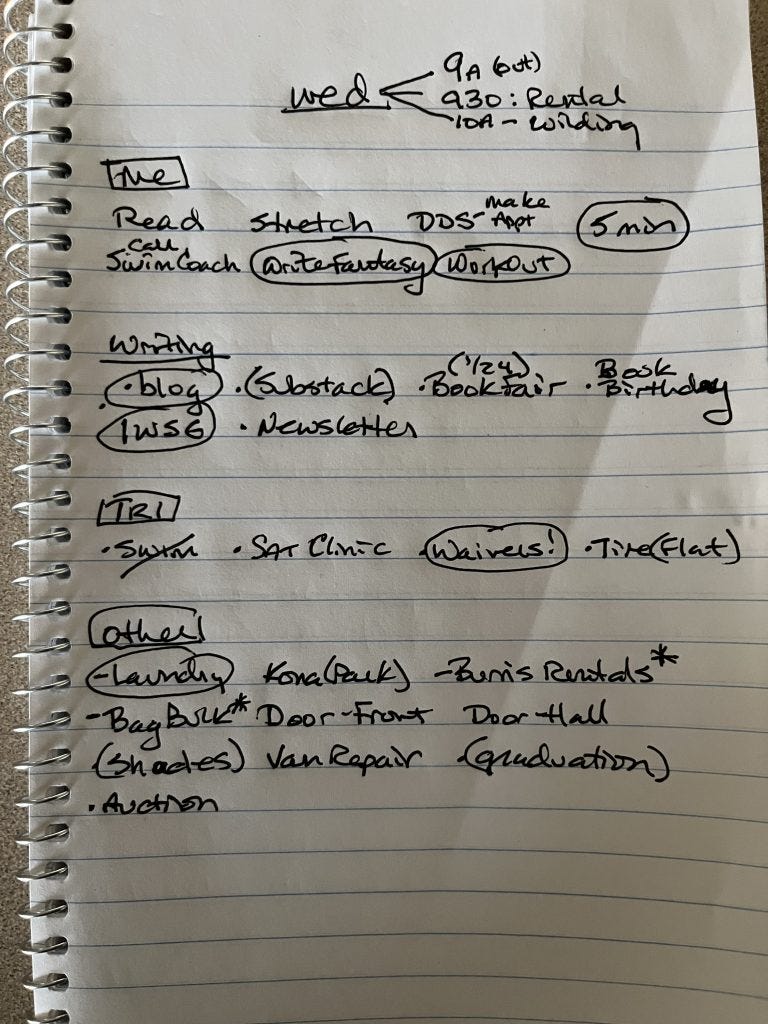
Consider circling all the things you really think must get done first. If there is a time element to it, make note of that (for example a doctor’s approintment time). I also add specific appointment times at the top of my daily list (see picture) to remind me when to get out the door (yes, my goal of not always being late could happen).
Stars:
Put stars next to things that can be done after completing the circled items.
Batch:
Similar tasks: Group together similar tasks. Sometimes this is obvious, like dropping into the grocery store on the way home from another errand (if you really need to grocery shop!).
Social Media/Email: pick ONCE a day to tap into these resources. Many of us repeatedly check email or social media. However, this is often unnecessary and become a time waster. (C’mon…once you’re into your Social Media, isn’t it easier to scroll a little longer than to go back to that laundry?)
Gravy- everything else on the list is extra. If you get it done today, great, but otherwise it can wait for tomorrow.
Don’t Start a New Fire!
Overlisting:
It’s tempting to spend so much time making lists (and sublists), that we never actually complete any items. At first, your list may be way too long. But with time, you’ll get used to what is reasonable to complete in a day, and consider moving some other items to the “Longer Project” list.
Honesty:
If there are items on your list you never really seem to complete or that fall victim to procrastination, take a hard look at the why. Often, the reasoning isn’t a lack of time, at all.
Fear can keep us from moving forward on a task (this is one reason some writer’s spend more time on Social Media than actually writing!). This may be a fear of failure or something deeper. Check out this post for more information.
Imposter syndrome can keep you from completing goals. (Here is a helpful post).
Multi-tasking:
Don’t try to do more than one thing at a time. We all fall victim to thinking we can multi-task, believing we will get everything done faster. What really happens is that each thing is slower and done less well. In addition, multi-tasking can have some long-term ramifications. If you’re shaking your head in disbelief, see this post with some great information and real data on multi-tasking.
There are *some* times that doing 2 things at the same time does make sense. For example, doing some editing while the clothes are washing, then taking a quick break to put the clothes in the dryer. This allows you to make good use of the time the washer is operating. It also affords a built-in mental break when you move the clothes to the dryer. (Yes! Something for you.)
Time Blocks:
Instead of ploughing through your list without any breaks, you’ll feel less stressed and actually accomplish more by giving yourself intentional breaks. This can easily be done by using a timer. For example, I set a timer for 45 minutes. During that time, I work on a task (or tasks). When the timer goes off, I reset it for 15 minutes during which I take a mental break. I do something for *me*.
To find out more about time control, check out the Pomodoro method (here).
Remove Distractions:
I could easily put social media under this section, too. But suffice it to say that putting your phone out of reach or unplugging from a distracting headset, may be a ticket to more productiveness. Give it a try!
What’s Done/What’s Not:
This part is pretty simple. Cross out what you finish, move to tomorrow’s list what you don’t get done today. Some things are repeated daily- I rewrite them every day anyway. It allows for consistency. Note: if something stays on the list and never gets done, go back up to the Honesty section, above!
Need some more tips and resources?
Here are some additional useful links:
What About You?
Do you have time management methods that work for you? Share them with us in the comments.

This post is part of a monthly blog share with other writers that help each other by sharing what works, what doesn’t, and everything in between. Check out some of the authors below, then head on over to the Insecure Writers Support Group to see what it’s all about.
Also, many thanks to this month’s blog hop hosts: Shannon Lawrence, Olga Godim, Jean Davis, and Jacqui Murray!
The post How to Find the Time to Write in a Busy Life first appeared on Miffie Seideman.